
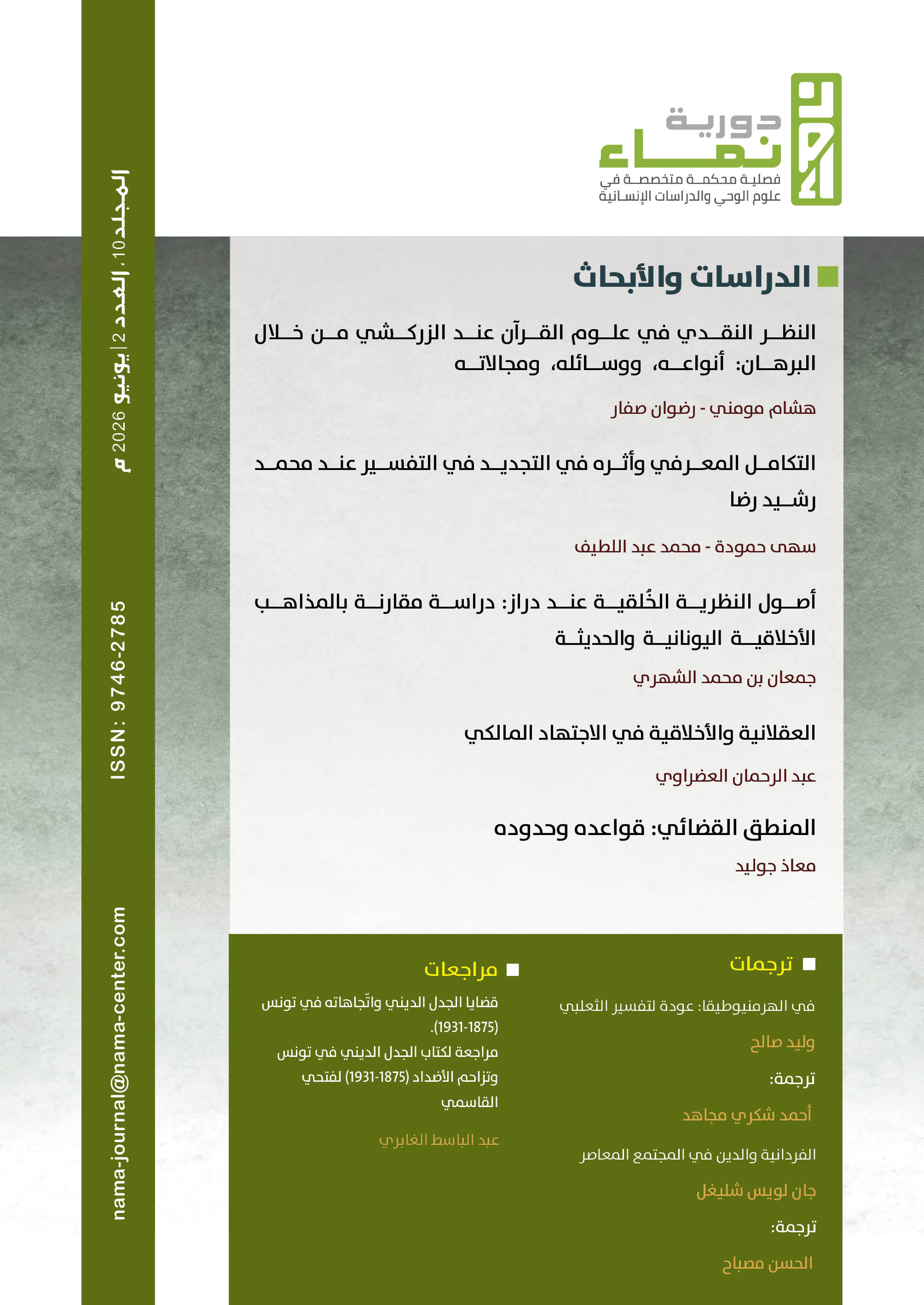
Judicial Logic: Its Rules and Limits

Article Sidebar
-
المنطق, الاستدلال, القضاء, الانحيازات المعرفية والسيكولوجية, التكوين القانوني Logic, Reasoning, Judiciary, Cognitive and Psychological Biases, Legal Education
Abstract
This study investigates the rules and limits of judicial logic, emphasizing how courts navigate between strict legal reasoning and ethical considerations. When legal texts are clear, judges apply logical and quasi-logical rules; but when texts are ambiguous or silent, they shift toward equitable reasoning, drawing upon ethical principles to resolve disputes. The limits of judicial logic emerge when cognitive and psychological biases distort reasoning, undermining the judiciary’s role as protector of rights and security, as well as when legal education neglects training in logical methods. By analyzing both the rules (Section I) and limits (Section II), the research highlights the complementary relationship between legal and ethical reasoning, while also exposing the detrimental effects of bias and insufficient logical training on judicial practice. It concludes with recommendations to reform legal education to strengthen logical thinking and to raise awareness of cognitive biases and strategies to mitigate them, thereby enhancing the soundness and integrity of judicial reasoning.
Full text article
References
شيلح، م. (2017). تأويل العقود في قانون الالتزامات والعقود المغربي: محاولة دراسة ميتودولوجية للفهم القضائي والفقهي للقانون التعاقدي (ط. 1). فاس: مختبر قانون الالتزامات والعقود بكلية الحقوق.
الماحي، ع. ب. م. (2021). الدور الإنشائي للاجتهاد القضائي في المادة المدنية: دراسة تأصيلية وعملية معززة بأكثر من 900 حكم وقرار قضائي (ط. 1). الرباط: مطبعة الأمنية.
References:
Adjaout-Ponsard, M. (2021). Biais cognitifs et comportement judiciaire. Les Cahiers de la justice, (3), 455–466.
Al-Mahi, A. B. M. (2021). The constructive role of judicial ijtihad in civil matters: A foundational and practical study supported by more than 900 judicial rulings and decisions (1st ed.). Rabat: Al-Amniya Press. (in Arabic)
Aristote. (1866). Les premiers analytiques (J. Barthélemy-Saint-Hilaire, Trans.). Paris: Ladrange.
Asano, Y. (2021). Le raisonnement juridique pluraliste (S. Serverin, Trans.). Droit et Société, (109), 647–662.
Berriat-Saint-Prix, F. (2017). Guide pour les thèses: Manuel de logique judiciaire (Éd. orig. 1855). Paris: Hachette BnF.
Capitant, H., Terré, F., Lequette, Y., & Chénedé, F. (2008). Les grands arrêts de la jurisprudence civile (Tome 2, 14e éd.). Paris: Dalloz.
Chilh, M. (2017). Interpretation of contracts in Moroccan law of obligations and contracts: A methodological study of judicial and jurisprudential understanding of contract law (1st ed.). Fez: Laboratory of Obligations and Contracts Law, Faculty of Law. (in Arabic)
Englich, B., Mussweiler, T., & Strack, F. (2005). The last word in court: A hidden disadvantage for the defense. Law and Human Behavior, 29(6), 705–722.
Epstein, L., Parker, C. M., & Segal, J. A. (2018). Do justices defend the speech they hate? An analysis of in-group bias on the U.S. Supreme Court. Journal of Law and Courts, 6(2), 245–274.
Goldszlagier, J. (2015). L’effet d’ancrage ou l’apport de la psychologie cognitive à l’étude de la décision judiciaire. Les Cahiers de la justice, (4), 693–704.
Goltzberg, S. (2021). L’argumentation juridique (5e éd.). Paris: Dalloz.
Greenwald, A. G., & Krieger, L. H. (2006). Implicit bias: Scientific foundations. California Law Review, 94(4), 945–967.
Guinchard, S., & Debard, T. (2024). Lexique des termes juridiques (32e éd.). Paris: Dalloz.
Herrera, C. M. (2012). Concepts juridiques et contraintes de l’argumentation. Droits, (55), 45–60.
Kakinohana, R. K., & Pilati, R. (2023). Differences in decisions affected by cognitive biases: Examining human values, need for cognition, and numeracy. Psicologia: Reflexão e Crítica, 36, Article 26.
Laprise, G. (2000). Les outils du raisonnement et de la rédaction juridique. Montréal: Les Éditions Thémis.
Lidén, M. (2018). Confirmation bias in criminal cases (Master’s thesis). Department of Law, Uppsala University, Sweden.
Martineau, F. (2023). Petit traité d’argumentation judiciaire et de plaidoirie (2e éd.). Paris: Dalloz.
Mathieu, B. (2024). Plaidoyer pour l’enseignement de la rhétorique dans les facultés de droit. Revue Droit & Littérature, (8), 123–138.
Nisbett, R. E., & Wilson, T. D. (1977). The halo effect: Evidence for unconscious alteration of judgments. Journal of Personality and Social Psychology, 35(4), 250–256.
Perelman, C. (1965). Le raisonnement juridique. Les Études philosophiques, 20(2), 163–179.
Perelman, C. (1979). Logique juridique: La nouvelle rhétorique (2e éd.). Paris: Dalloz.
Perelman, C., & Olbrechts-Tyteca, L. (2008). Traité de l’argumentation: La nouvelle rhétorique (6e éd.). Paris: Normandie Roto Impression.
Soeteman, A. (2003). Legal logic? Or can we do without? Artificial Intelligence and Law, 11(1–2), 197–210.
Terré, F. (Ed.). (2011). Pour une réforme du droit de la responsabilité civile. Paris: Dalloz.
Vorms, M. (2021). Bayes et les biais: Le « biais de confirmation » en question. Revue de Métaphysique et de Morale, (4), 467–482.
Zrouqi, M. (2022). Legal methodology: Part one—Jurisprudential, legislative, and judicial methodology (2nd ed.). Tunis: Author. (in Arabic)
Authors
Copyright (c) 2026 معاذ جوليد

This work is licensed under a Creative Commons Attribution-NonCommercial 4.0 International License.
yright and License
Researchers always have copyright. The research published in the Journal is licensed under the Creative Commons Attribution-Noncommercial 4.0 International License. This means that every person can download, read and use the research, provided that he/she relates it to its author appropriately, stating any amendments made. This work cannot be used for commercial purposes.