
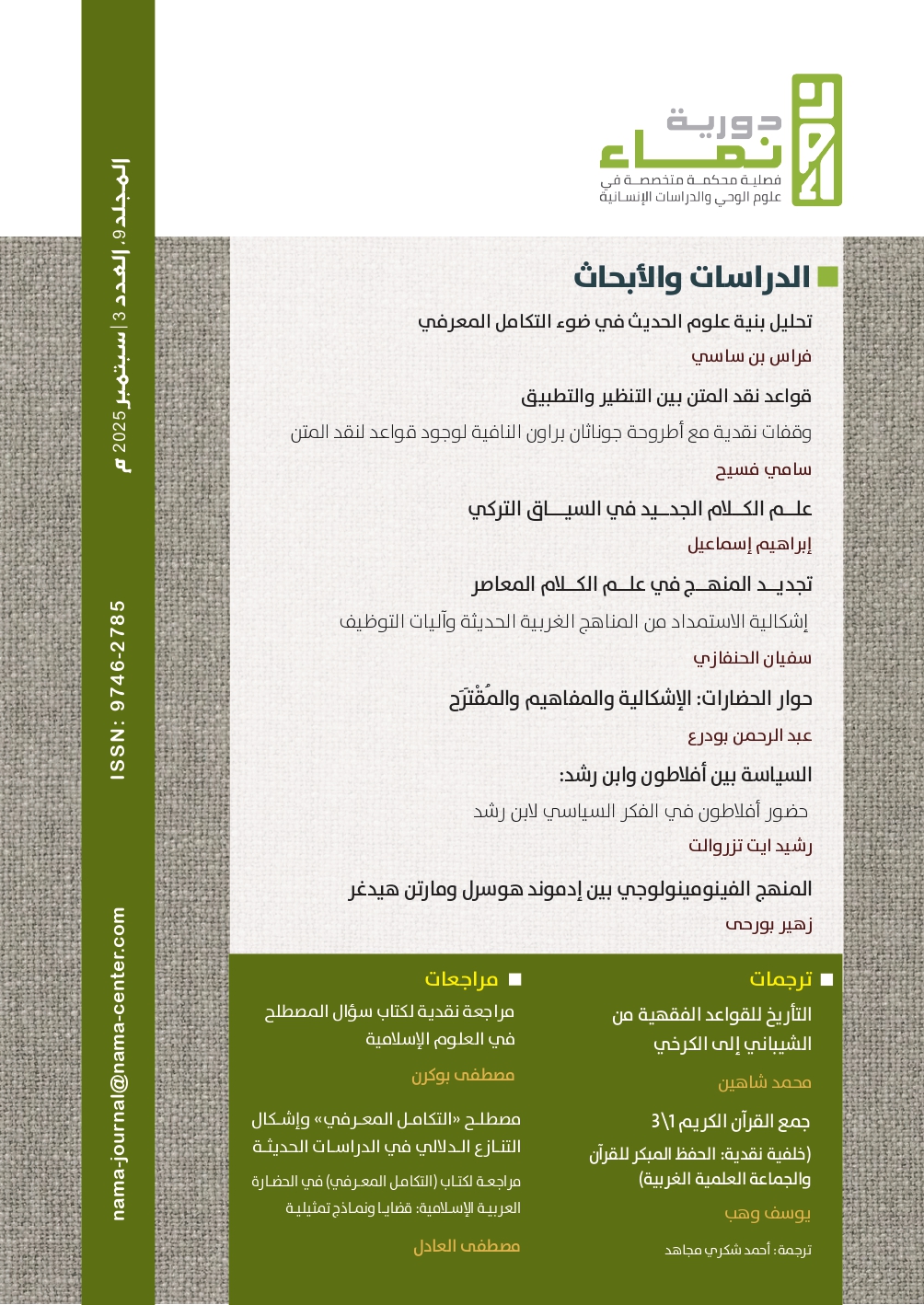
Collection of the Holy Quran 1/3 Critical Background: Early Preservation of the Qur’an and the Western Scientific Community

Article Sidebar
-
نقل القرآن الكريم, التأليف والتقنين, النقد النصي, المنهج التاريخي-النقدي, التراث الفكري الإسلامي Transmission of the Holy Qur'an, Authorship and Codification, Textual Criticism, Historical-Critical Methodology, Islamic Intellectual Heritage
Abstract
This article explores the early transmission of the Holy Qur’an through memorization, recitation, and writing, emphasizing the profound scholarly, practical, and spiritual efforts that ensured its preservation during the Prophet’s time. It delves into the interplay between oral and written traditions, examining issues of authorship and codification by referencing classical Islamic sources and modern research from both Western academia and the contemporary Islamic world. As the first in a trilogy, the article lays the groundwork for understanding the historical documentation of the Qur’anic text and engages with key debates in Western Qur’anic studies, particularly those shaped by historical-critical and revisionist perspectives. It critiques the dominance of Western philological and textual methodologies imposed on Islamic discourse, challenging the notion of academic neutrality and exposing the epistemological bias in Orientalist scholarship. Ultimately, the article advocates for a more balanced and authentic approach that respects the epistemological and methodological foundations of traditional Islamic thought, urging readers to reexamine prevailing paradigms and engage with the Qur’an on its own intellectual terms.
Full text article
References
ابن منظور، ج. د. (1997). لسان العرب (15 مجلدات). دار صادر.
المكي، أ. ط. (2001). قوت القلوب في معاملة المحبوب ووصف طريق المريد إلى مقام التوحيد (تحقيق محمود الرضواني، 3 مجلدات). مكتبة دار التراث.
الماوردي، أ. ح. (د.ت). النكت والعيون (تحقيق السيد عبد المقصود، 6 مجلدات). دار الكتب العلمية.
الصاوي، أ. ب. م. (د.ت). حاشية على تفسير الجلالين (تحقيق علي الضباع، 4 مجلدات). دار الجيل.
السيوطي، ج. د. (2003). الدر المنثور في التفسير بالمأثور (تحقيق عبد الله التركي، 17 مجلدات). مركز هجر للبحوث والدراسات العربية والإسلامية.
الونشريسي، أ. (1981). المعيار المعرب والجامع المغرب (تحقيق محمد حجي، 13 مجلدات). وزارة الأوقاف والشؤون الإسلامية بالمملكة المغربية؛ دار الغرب الإسلامي.
اليحصبي، ع. ب. م. (1960–1983). ترتيب المدارك وتقريب المسالك (تحقيق ابن تاويت الطنجي، عبد القادر الصحراوي، محمد بن شريفة، وسعيد أحمد أعراب، 8 مجلدات). مطبعة فضالة.
بدوي، ع. ر. (1998). دفاع عن القرآن ضد منتقديه. مكتبة مدبولي الصغير.
بنت الشاطئ، ع. ع. ر. (2004). الإعجاز البياني للقرآن ومسائل ابن الأزرق. دار المعارف.
بلاشير، ر. (1974). القرآن: نزوله تدوينه ترجمته وتأثيره (ترجمة رضا سعادة). دار الكتاب اللبناني.
جولدتسيهر، أ. (1944). المذاهب الإسلامية في تفسير القرآن (ترجمة علي عبد القادر). مطبعة العلوم بشارع الخليج.
الحاج، س. (2002). نقد الخطاب الاستشراقي: الظاهرة الاستشراقية وأثرها في الدراسات الإسلامية. دار المدار الإسلامي.
إسماعيل، ش. (1982). القراءات: أحكامها ومصدرها. رابطة العالم الإسلامي.
عتر، ح. (1988). الأحرف السبعة ومنزلة القراءات منها. دار البشائر الإسلامية.
جبل، م. (2002). الرد على المستشرق اليهودي جولد تسيهر في مطاعنه على القراءات القرآنية. جامعة الأزهر، كلية القرآن الكريم.
الكوثري، م. ز. (د.ت). مقالات الكوثري. المكتبة التوفيقية.
الكوثري، م. ز. (2005). من عبر التاريخ في الكيد للإسلام. المكتبة الأزهرية للتراث.
خليفة، إ. (1979). دراسات في مناهج المفسرين. جامعة الأزهر، كلية أصول الدين.
القاضي، ع. ف. (2005). القراءات في نظر المستشرقين والملحدين. دار السلام.
السباعي، م. (د.ت). الاستشراق والمستشرقون: ما لهم وما عليهم. دار الوراق للنشر والتوزيع.
Arabic reference
al-Bayhaqī, A. b. (1988). Dalāʾil al-nubuwwa (ʿAbd al-Muʿṭī Qalʿajī, Ed.; 7 vols.). Dār al-Kutub al-ʿIlmiyya.
Ibn Manẓūr, J. al-D. (1997). Lisān al-ʿArab (15 vols.). Dār Ṣādir.
al-Makkī, A. Ṭ. (2001). Qūt al-qulūb fī muʿāmalat al-maḥbūb wa-waṣf ṭarīq al-murīd ilā maqām al-tawḥīd (Maḥmūd al-Raḍwānī, Ed.; 3 vols.). Maktabat Dār al-Turāth.
al-Māwardī, A. al-Ḥ. (n.d.). al-Nukat wa-l-ʿuyūn (al-Sayyid ʿAbd al-Maqṣūd, Ed.; 6 vols.). Dār al-Kutub al-ʿIlmiyya.
al-Ṣāwī, A. b. M. (n.d.). Ḥāshiya ʿalā Tafsīr al-Jalālayn (ʿAlī al-Ḍibāʿ, Ed.; 4 vols.). Dār al-Jīl.
al-Suyūṭī, J. al-D. (2003). al-Durr al-manthūr fī al-tafsīr bi-l-maʾthūr (ʿAbd Allāh al-Turkī, Ed.; 17 vols.). Markaz Hajr li-l-Buḥūth wa-l-Dirāsāt al-ʿArabiyya wa-l-Islāmiyya.
al-Wansharīsī, A. (1981). al-Miʿyār al-muʿrib wa-l-jāmiʿ al-mughrib (Muḥammad Ḥajjī, Ed.; 13 vols.). Wizārat al-Awqāf wa-l-Shuʾūn al-Islāmiyya bi-l-Mamlaka al-Maghribiyya; Dār al-Gharb al-Islāmī.
al-Yaḥṣubī, ʿI. b. M. (1960–1983). Tartīb al-madārik wa-taqrīb al-masālik (Ibn Tāwīt al-Ṭanjī, ʿAbd al-Qādir al-Ṣaḥrāwī, Muḥammad b. Sharīfa, & Saʿīd Aḥmad Aʿrāb, Eds.; 8 vols.). Maṭbaʿat Faḍāla.
Badawī, ʿA. R. (1998). Difāʿ ʿan al-Qurʾān ḍidd muntaqidīhi. Maktabat Madbūlī al-Ṣaghīr.
Bint al-Shāṭiʾ, ʿĀ. ʿA. R. (2004). al-Iʿjāz al-bayānī li-l-Qurʾān wa-masāʾil Ibn al-Azraq. Dār al-Maʿārif.
Blachère, R. (1974). al-Qurʾān: Nuzūluhu tadwīnuhu tarjamatuhu wa-taʾthīruhu (Riḍā Saʿāda, Trans.). Dār al-Kitāb al-Lubnānī.
Goldziher, I. (1944). al-Madhāhib al-islāmiyya fī tafsīr al-Qurʾān (ʿAlī ʿAbd al-Qādir, Trans.). Maṭbaʿat al-ʿUlūm bi-Shāriʿ al-Khalīj.
al-Ḥājj, S. (2002). Naqd al-khiṭāb al-istishrāqī: al-ẓāhira al-istishrāqiyya wa-atharuhā fī al-dirāsāt al-islāmiyya. Dār al-Madār al-Islāmī.
Ismāʿīl, Sh. (1982). al-Qirāʾāt: Aḥkāmuhā wa-maṣdaruha. Rābiṭat al-ʿĀlam al-Islāmī.
ʿItr, Ḥ. (1988). al-Aḥruf al-sabʿa wa-manzilat al-qirāʾāt minhā. Dār al-Bashāʾir al-Islāmiyya.
Jabal, M. (2002). al-Radd ʿalā al-mustashriq al-yahūdī Goldziher fī maṭāʿinahu ʿalā al-qirāʾāt al-Qurʾāniyya. Jāmiʿat al-Azhar, Kulliyyat al-Qurʾān al-Karīm.
al-Kawtharī, M. Z. (n.d.). Maqālāt al-Kawtharī. al-Maktaba al-Tawfīqiyya.
al-Kawtharī, M. Z. (2005). Min ʿibar al-tārīkh fī al-kayd li-l-islām. al-Maktaba al-Azharīya li-l-Turāth.
Khalīfa, I. (1979). Dirāsāt fī manāhij al-mufassirīn. Jāmiʿat al-Azhar, Kulliyyat Uṣūl al-Dīn.
al-Qāḍī, ʿA. F. (2005). al-Qirāʾāt fī naẓar al-mustashriqīn wa-l-mulḥidīn. Dār al-Salām.
al-Sibāʿī, M. (n.d.). al-Istishrāq wa-l-mustashriqūn: Mā lahum wa-mā ʿalayhim. Dār al-Warrāq li-l-Nashr wa-l-Tawzīʿ.
English reference
al-ʿAẓamī, M. M. (200 3). The history of the Qurʾānic text from revelation to compilation: A comparative study with the Old and New Testaments. UK Islamic Academy.
Badawī, A. R. (1983). Défense du Coran contre ses critiques. Presses Universitaires de France.
Buck, C. (2006). Discovering. In A. Rippin (Ed.), The Blackwell companion to the Qurʾān. Blackwell Publishing.
Burton, J. (1977). The collection of the Qurʾān. Cambridge University Press.
Burton, J. (1993). Law and exegesis: The penalty for adultery in Islam. In J. R. Hawting & A.-K. A. Shareef (Eds.), Approaches to the Qurʾan. Routledge.
Cook, M. (2004). A Koranic codex inherited by Mālik from his grandfather. In Studies in the origins of early Islamic culture and tradition. Ashgate.
Cook, M. (2004). The stemma of the regional codices of the Koran. Graeco-Arabica, 9–10, 89–104.
Cook, M., & Crone, P. (1977). Hagarism: The making of the Islamic world. Cambridge University Press.
Crone, P. (1992). Serjeant and Meccan trade. Arabica, 39(2), 219–240.
Dayeh, I. (2019). Prophecy and writing in the Qur’an, or why Muhammad was not a scribe. In H. M. Zellentin (Ed.), The Qur’an’s reformation of Judaism and Christianity. Routledge.
Donner, F. (1998). Narratives of Islamic origins: The beginnings of Islamic historical writing. Darwin Press.
El-Awa, S. M. S. (2006). Linguistic structure. In A. Rippin (Ed.), The Blackwell companion to the Qurʾān. Blackwell Publishing.
Foucault, M. (1979). What is an author? In J. Harari (Ed.), Textual strategies: Perspectives in post-structuralist criticism (pp. 141–160). Cornell University Press.
Gilliot, C. (2006). Creation of a fixed text. In J. D. McAuliffe (Ed.), The Cambridge companion to the Qur’an. Cambridge University Press.
Goudarzi, M. (2022). The written Torah and the oral Qur’an in pagan Mecca: Towards a new reading of Q 6:91. In B. Fudge et al. (Eds.), Non sola scriptura: Essays on the Qur’an and Islam in honour of William A. Graham. Routledge.
Graham, W. A. (1987). Beyond the written word: Oral aspects of scripture in the history of religion. Cambridge University Press.
Harshaw (Hrushovski), B. (1984). Fictionality and fields of reference: Remarks on a theoretical framework. Poetics Today, 5(2), 227–251.
Jaffee, M. S. (2003). Torah in the mouth: Writing and oral tradition in Palestinian Judaism, 200 BCE–400 CE. Oxford University Press.
Kuhn, T. (1970). The structure of scientific revolutions. University of Chicago Press.
Lumbard, J. (2022). Decolonizing Qur’anic studies. Religions, 13(167). https://doi.org/10.3390/rel13020167
McDonald, L. (2020). Fluidity in the early formation of the Hebrew Bible. Hebrew Studies, 61, 73–95.
Metzger, B. M. (1992). The text of the New Testament: Its transmission, corruption, and restoration. Oxford University Press.
Motzki, H. (2001). The collection of the Qurʾān: A reconsideration of Western views in light of recent methodological developments. Der Islam, 78(1), 1–34.
Nekroumi, M. (2009). The modern Qurʾānic debate: An introduction. In M. Nekroumi & J. Meise (Eds.), Modern controversies in Qurʾānic studies. EB-Verlag.
Neuwirth, A. (2007). Orientalism in oriental studies? Qur’anic studies as a case in point. Journal of Qur’anic Studies, 9(2), 112–127.
Neuwirth, A. (2014). Scripture, poetry and the making of the community: Reading the Qur’an as a literary text. Oxford University Press.
Neuwirth, A. (1996). Vom Rezitationstext über die Liturgie zum Kanon. In S. Wild (Ed.), The Qurʾān as text. Brill.
Nöldeke, T., Schwally, F., Bergsträßer, G., & Pretzl, O. (2013). The history of the Qurʾān. Brill.
Van Putten, M. (2019). “The grace of God” as evidence for a written Uthmanic archetype: The importance of shared orthographic idiosyncrasies. Bulletin of the School of Oriental and African Studies, 82(2), 271–278.
Reynolds, G. S. (2010). The Qurʾān and its biblical subtext. Routledge.
Rippin, A. (2020). Academic scholarship and the Qur’an. In M. Shah & M. A. Haleem (Eds.), The Oxford handbook of Qur’anic studies. Oxford University Press.
Sadeghi, B., & Goudarzi, M. (2012). Ṣanʿāʾ 1 and the origins of the Qurʾān. Der Islam, 87(1–2), 1–129.
Sadeghi, B., & Bergmann, U. (2010). The codex of a companion of the Prophet and the Qurʾān of the Prophet. Arabica, 57, 343–436.
Saleh, W. (2010). The etymological fallacy and Qur’anic studies: Muhammad, paradise, and Late Antiquity. In A. Neuwirth, N. Sinai, & M. Marx (Eds.), The Qurʾān in context. Brill.
Schoeler, G. (2010). The codification of the Qur’an: A comment on the hypotheses of Burton and Wansbrough. In A. Neuwirth, N. Sinai, & M. Marx (Eds.), The Qurʾān in context. Brill.
Sidky, H. (2023). Consonantal dotting and the oral Quran. Journal of the American Oriental Society, 143(4), 767–794.
Sidky, H. (2020). On the regionality of Qurʾānic codices. Journal of the International Qur’anic Studies Association, 5(1), 133–210.
Sinai, N. (2014). When did the consonantal skeleton of the Quran reach closure? Part II. Bulletin of the School of Oriental and African Studies, 77(3), 509–521.
Smith, B. (1978). On the margins of discourse: The relation of literature to language. University of Massachusetts Press.
Stewart, D. J. (2024). Ignoring the Bible in Qur’anic studies scholarship of the late twentieth century. Reorient, 9(1), 25–45.
ʿUthmānī, M. T. (2023). Approaching the Qur’anic sciences. Turath.
Wansbrough, J. (2004). Qurʾānic studies: Sources and methods of scriptural interpretation. Prometheus Books. (Original work published 1977)
Whelan, E. (1998). Forgotten witness: Evidence for the early codification of the Qurʾān. Journal of the American Oriental Society, 118(1), 1–14.
Zadeh, T. (2015). Qur’anic studies and the literary turn. Journal of the American Oriental Society, 135(2), 223–243.
Authors
Copyright (c) 2025 أحمد شكري مجاهد

This work is licensed under a Creative Commons Attribution-NonCommercial 4.0 International License.
yright and License
Researchers always have copyright. The research published in the Journal is licensed under the Creative Commons Attribution-Noncommercial 4.0 International License. This means that every person can download, read and use the research, provided that he/she relates it to its author appropriately, stating any amendments made. This work cannot be used for commercial purposes.