
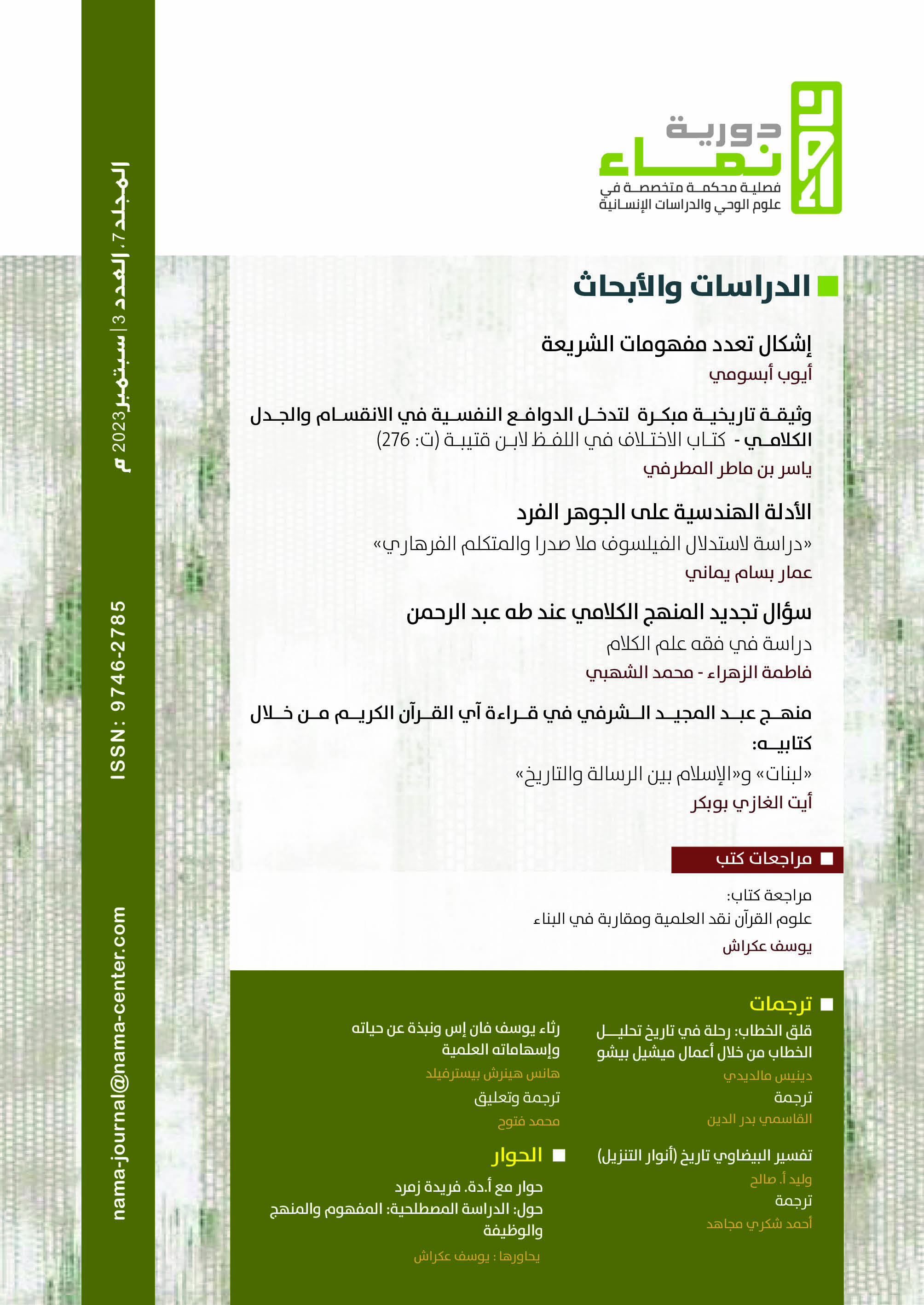
Al-Badhawi’s Interpretation History of (Anwar Al-Tanzeel)

Article Sidebar
Abstract
The Qur’an commentary Anwār al-tanzīl of al-Bayḍāwī (d. 719/1319) was one of the most important works of the Islamic religious tradition. As a universally adopted Sunni text for teaching tafsīr, it was ubiquitous, read even in Safavid Iran. This was a work used by all Sunni schools, and as such was beyond the legal divisions of madhāhib. The history of this work is, however, uncharted. This article follows the trajectory of this work and traces the history of its rise to predominance, when and why it was adopted, and how the new significance it gained after the ninth/fifteenth century was projected back to the period it was written. It explores how the Anwār replaced al-Zamakhsharī’s (d. 538/1144) al-Kashshāf in scholarly circles in Cairo before going on to gain universalised authority in the Ottoman realms. Following this, I address the deep-rooted connections that existed between the scholars of Cairo and Istanbul, and how late Mamluk developments in Cairo came to full fruition in Istanbul. The eclipse of the Anwār by the Qur’an commentary of Ibn Kathīr (d. 774/1372) in the twentieth century is also outlined, and a list of the published glosses of Anwār is supplied in an appendix.
Full text article
Authors

This work is licensed under a Creative Commons Attribution-NonCommercial 4.0 International License.
yright and License
Researchers always have copyright. The research published in the Journal is licensed under the Creative Commons Attribution-Noncommercial 4.0 International License. This means that every person can download, read and use the research, provided that he/she relates it to its author appropriately, stating any amendments made. This work cannot be used for commercial purposes.