
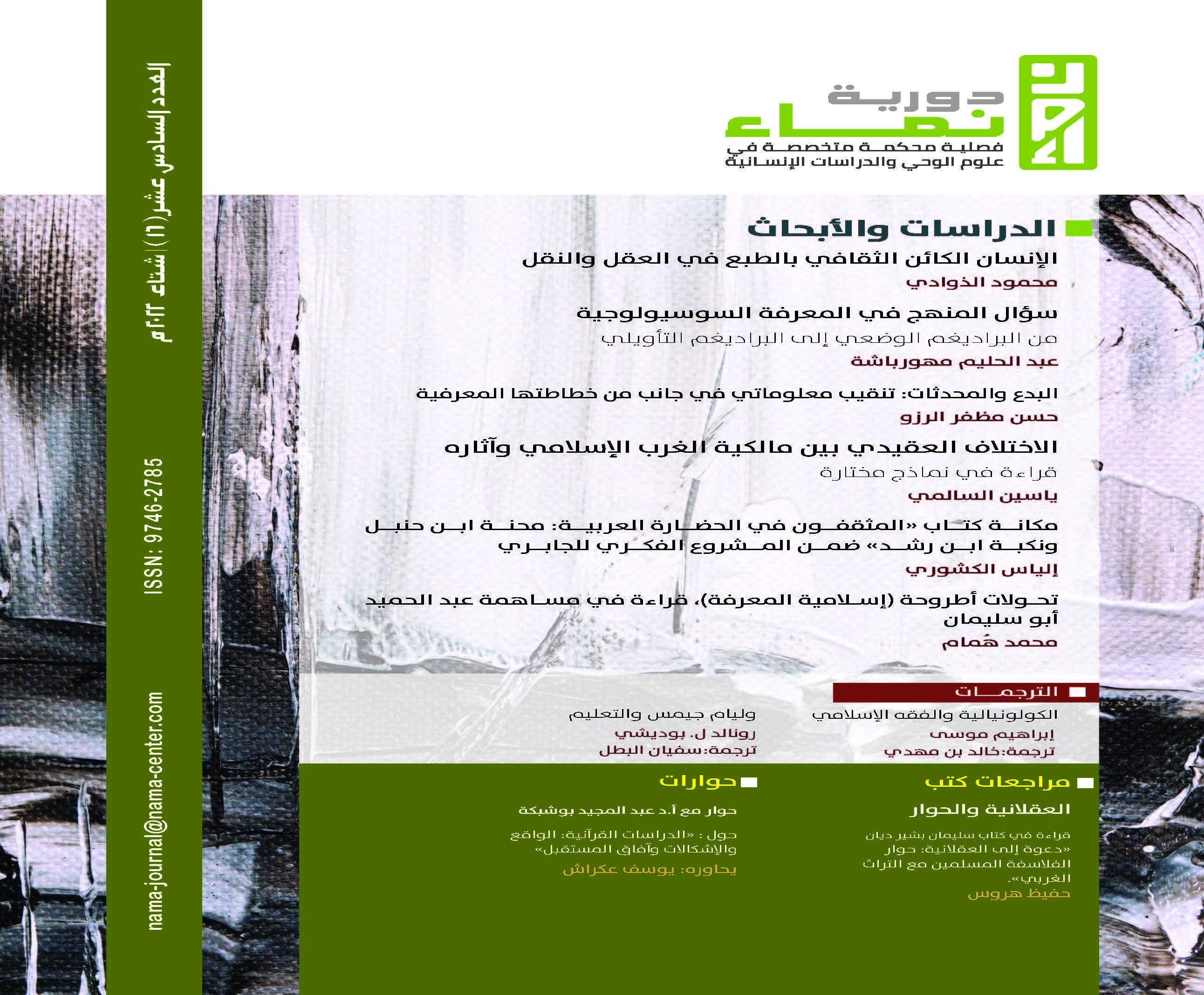
Transformations in the ‘Islamiization of knowledge’ project: A reading in the contribution of Abdel Hamid Abu Sulayman

Article Sidebar
-
إسلامية المعرفة, الفكر الإسلامي, الجمع بين القراءتين, تكامل العلوم, الاستخلاف Islamic knowledge, Islamic thought, Combining the two readings, Integration of sciences, succession
Abstract
This study addresses the biography of Abdel Hamid Abu Suleiman, and his scientific path. It also focuses on its scientific formation, both in terms of the epistemological vision or in terms of the critical approach that distinguished it. The study also highlights his contribution from within the institution of the International Institute of Islamic Thought (IIIT) in Washington in the processes of Islamic intellectual and methodological reform; by recourse to explanatory concepts based on the (Ethical vision), and the concepts of (ISTIKHLAF), (AADL), and (IAMAR). The study explain his contribution, along with Ismail Raji Al-Farouqi and Taha Jaber Al-Alwani, in establishing the Association of Muslim Social Scientists (AMSS), to link Islamic sciences and contemporary social sciences, and crystallize the new thesis of contemporary Islamic thought, under the name (Islamic Knowledge) ; A thesis based on philosophy and criticism, from within the equation (the integration of the world of the unseen and the world of testimony), or what I call referred to later in other writings: (combining the two readings). The study shows how Abdel Hamid Abu Suleiman sought to rid the thesis of contemporary Islamic thought from the dynamic and political tendency, by taking advantage of the scientific efforts of the Malaysian thinker Muhammad Naqib al-Attas, and the Sudanese thinker Muhammad Abu al-Qasim Haj Hamad, for any framework of the thesis: (universal monotheism) versus (religious theology) ), and (nihilistic condition). The study also presented, in this context, the effort of Abd el-Hamid Abu Suleiman in overcoming the crisis situation that the classical paradigm (forensic sciences) reached, with its tools, concepts and history.
Full text article
Authors

This work is licensed under a Creative Commons Attribution-NonCommercial 4.0 International License.
yright and License
Researchers always have copyright. The research published in the Journal is licensed under the Creative Commons Attribution-Noncommercial 4.0 International License. This means that every person can download, read and use the research, provided that he/she relates it to its author appropriately, stating any amendments made. This work cannot be used for commercial purposes.