
Aristotle’s Book of Gamma: Study and Analysis

Article Sidebar
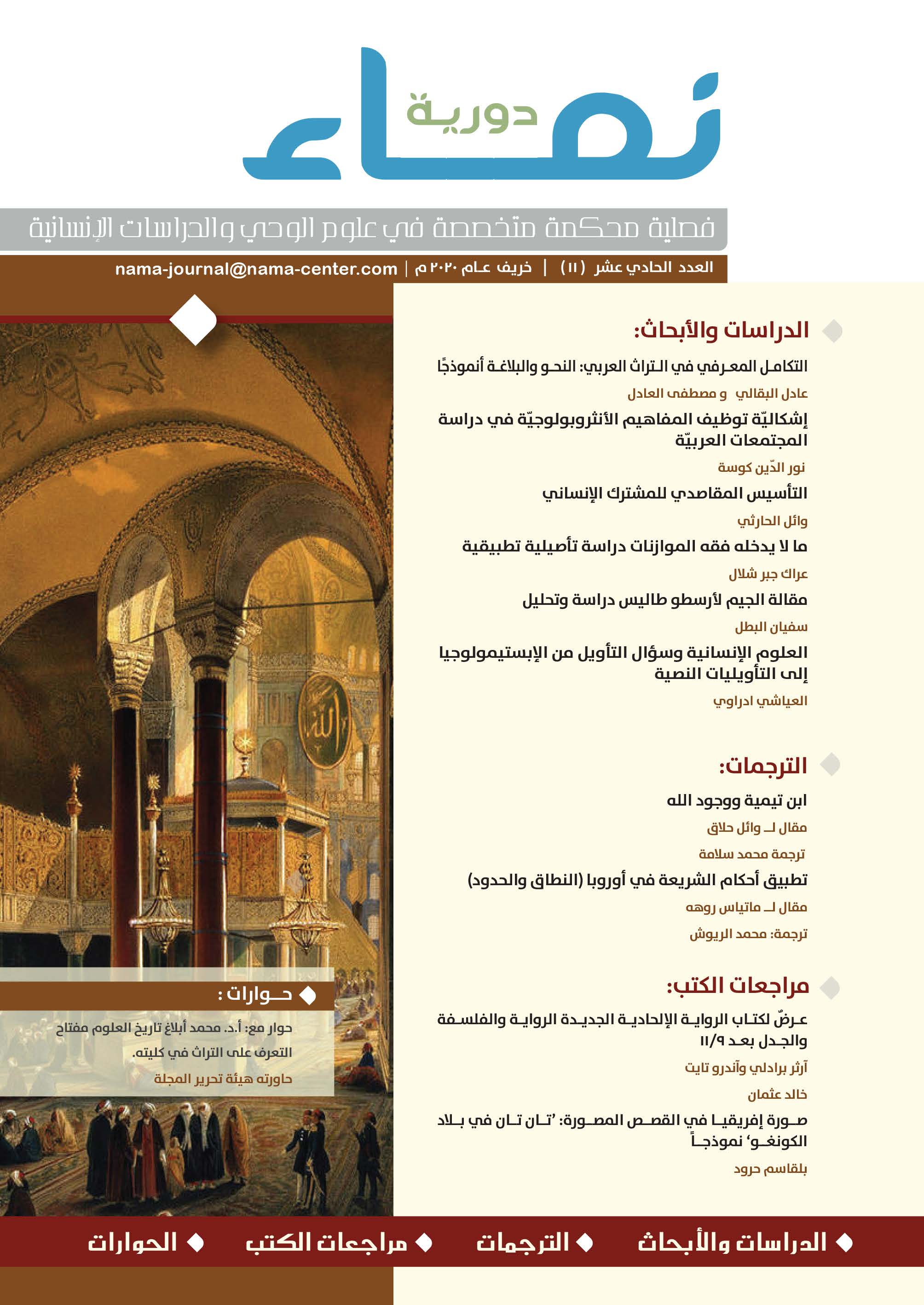
-
الثالث المرفوع, الدلالة, الهوية الدلالية, التأويل The Principle of Excluded Middle, Semantics, Semantic Identity, Interpretation
Abstract
The research aims to study and analyze Aristotle’s Book of Gama, which is considered one of the important Aristotelian works devoted to the idea of meaning resolution, which rarely received enough attention from researchers and scholars. Hence, the focus of our work will be shedding light on this Aristotelian production in an attempt to highlight its intellectual dimensions and connotations, and how they are also related to Ibn Rushd's efforts to explain and summarize the problem of the disintegration of the signification and the conflicting systems of meaning, which resulted in the decline of the philosophical discourse. So how can meaning be preserved? It was divided into axes: First: From Plato to Aristotle: Semantic Identity, Second: Aristotle's Book of Gama and the resolution of meaning, Third: The Greek Interpretive Project: Unity or Plurality? The research concluded that the problem of significance and meaning in the Book of Gama is a problem that is strongly linked to the opposition of the people of sophism or sophistical fallacies on the basis of two basic principles: the principle of non-contradiction and the principle of excluded middle. In this respect, Barbara's reading of this article, i.e. the Book of Gama, was a reading of ending the conflict and saying that perception for Aristotle is a semantic and logical perception and that something is not outside the meaning, and that the signification is the indication of something or the saying of something.
Full text article
Authors

This work is licensed under a Creative Commons Attribution-NonCommercial 4.0 International License.
yright and License
Researchers always have copyright. The research published in the Journal is licensed under the Creative Commons Attribution-Noncommercial 4.0 International License. This means that every person can download, read and use the research, provided that he/she relates it to its author appropriately, stating any amendments made. This work cannot be used for commercial purposes.