
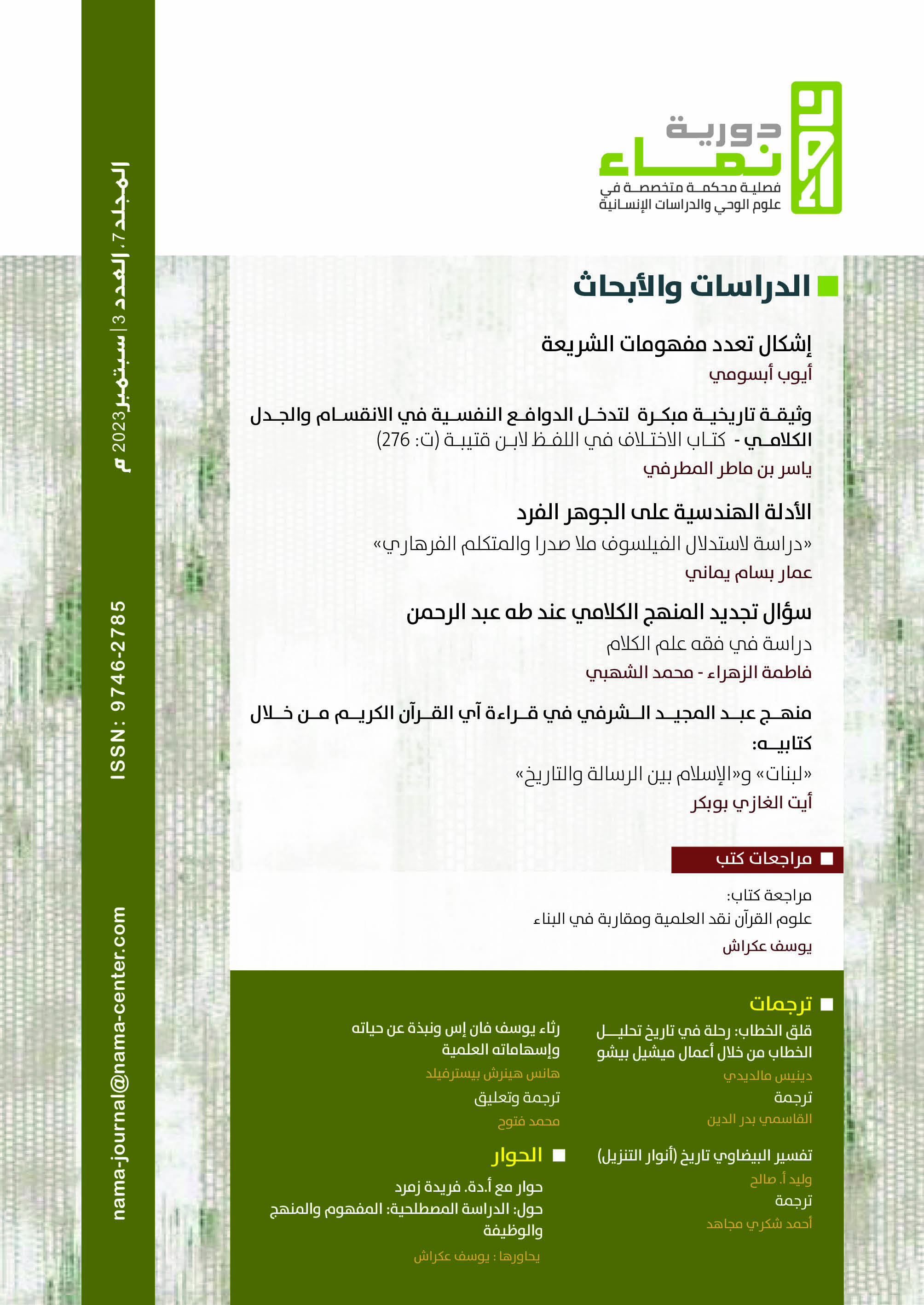
Abdelmajid Charfi's Approach to Reading the Holy Quran Through his books: "Labinate" and "Islam Between Message and History

Article Sidebar
-
القراءات المعاصرة, القراءات الحداثية, الفكر الإسلامي, عبد المجيد الشرفي Contemporary Readings, Modernist Readings, Verses of the Holy Quran, Islamic Thought, Abdul Majeed Al-Sharafi
Abstract
The research seeks to scrutinize contemporary readings of the Holy Quran in our Islamic thought through the Tunisian model, which is among the Islamic countries where the greatest number of voices are heard calling for a new approach to the religious phenomenon, because of its history and being influenced by a long and old dialogue with Europe and its critical mind. Al-Sharafi Abdul Majid is one of the sons of this country, who has demonstrated in his writings an unrivaled boldness in which his predecessor may not share an independent scholar position. He devoted his effort to a systematic critical examination of religious sources, in the light of historical criticism. It also radically revisits the interpretations of the first generations of Muslims and the renewal of the interpretive function of Islam as a religion that gives meaning to the world and, like them, calls for a linguistic reading of the Holy Quran by begging for approaches imported from the Western philosophy, and then applying a deconstructive reading of the Qur'anic text confirming the absence of a single reading of the text as did Mohamed Arkoun and Nasr Hamid Abu Zayd, and many others.
Full text article
Authors

This work is licensed under a Creative Commons Attribution-NonCommercial 4.0 International License.
yright and License
Researchers always have copyright. The research published in the Journal is licensed under the Creative Commons Attribution-Noncommercial 4.0 International License. This means that every person can download, read and use the research, provided that he/she relates it to its author appropriately, stating any amendments made. This work cannot be used for commercial purposes.