
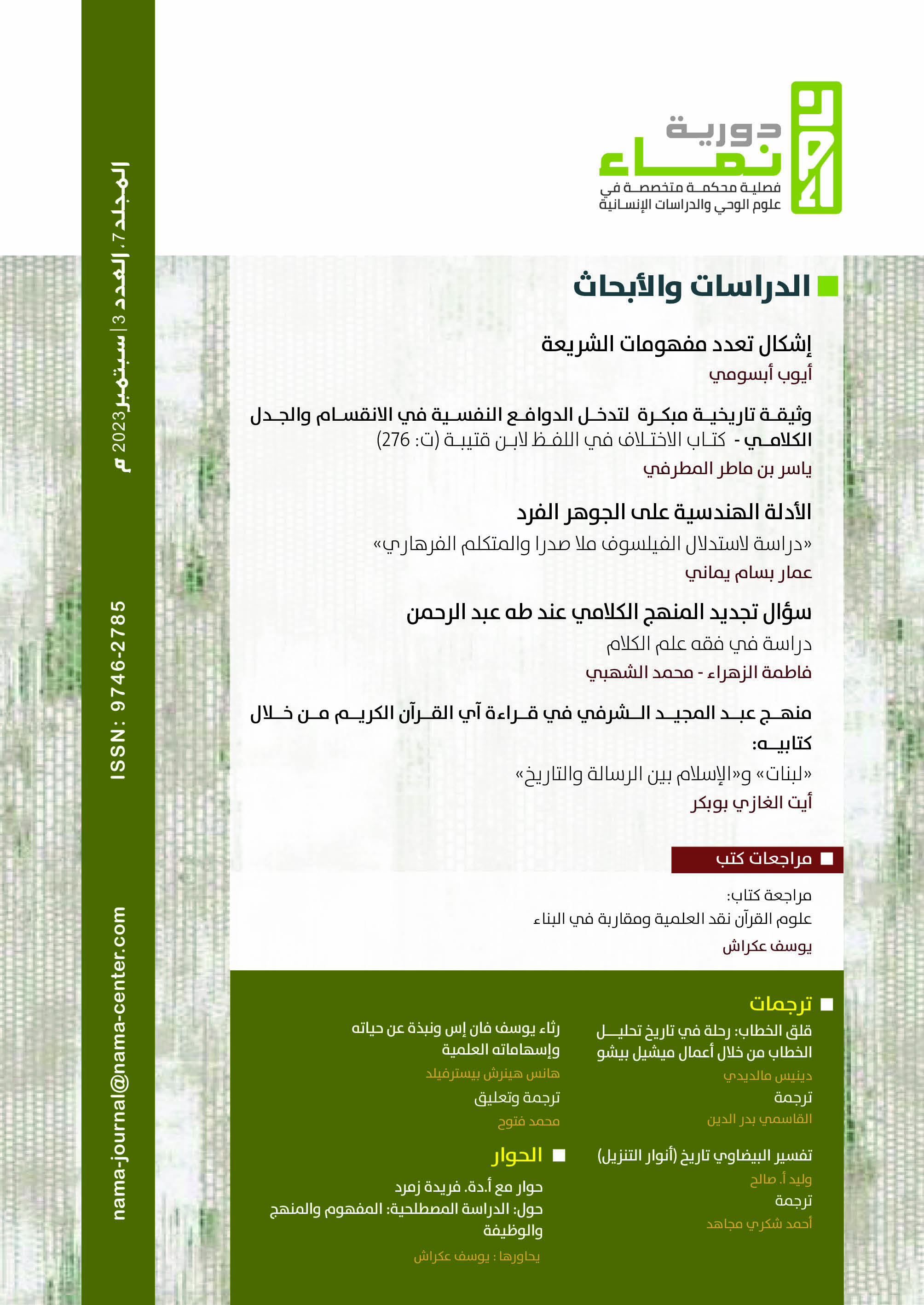
The Question of Renewing the Kalam (Theological) Method according to Taha Abdel Rahman A Study in the Jurisprudence of Kalam

Article Sidebar
-
الكلام الجديد, الحوارية, المناظرة, قياس التمثيل, الجدل New Theology, Dialogue, Debate, Measurement of Instance, Controversy
Abstract
The renewal of the theological method according to Taha Abdel Rahman is based on the reversal of the rupture with heritage and on the principle of proportionality between the method and the subject, and from them he aimed to revive and modernize the tools of debate and measurement of representation, in pursuit of practical certainty in the first tool, and in order to seek scientific certainty in the second. Overcoming the estrangement, he highlighted the original methodological role of science by taking note of the mechanisms of advanced speakers in facing intellectual challenges because of their methodological excellence, and to enable them to be open to methodological developments and benefit from modern dialogic logic. The motive for updating argumentative tools in dialogue and strengthening persuasive means is this at the procedural level, while at the rooting level, it enables the return of modern scientific tools and principles to it, just as the applicants used to return logic to controversy. This paper aimed to clarify what is meant by the term renewal in general, and the term "new theology" in particular, to highlight the methodological premises that Taha Abdel Rahman considers an entry point for theological renewal, and to criticize and evaluate some of the shortcomings in his claim. The most important conclusion is that the claim of reviving the methodological mechanisms of the speakers did not include the product of the latecomers, although it is not without aspects of creativity and methodological and critical depth, which also helps to revive the queen of arguments to combat modern suspicions, by virtue of the proximity of many of their criticisms to some contemporary Western philosophers. The omission of the historical development of some terms and methodological tools may prevent their depth of comprehension and good investment.
Full text article
Authors

This work is licensed under a Creative Commons Attribution-NonCommercial 4.0 International License.
yright and License
Researchers always have copyright. The research published in the Journal is licensed under the Creative Commons Attribution-Noncommercial 4.0 International License. This means that every person can download, read and use the research, provided that he/she relates it to its author appropriately, stating any amendments made. This work cannot be used for commercial purposes.