
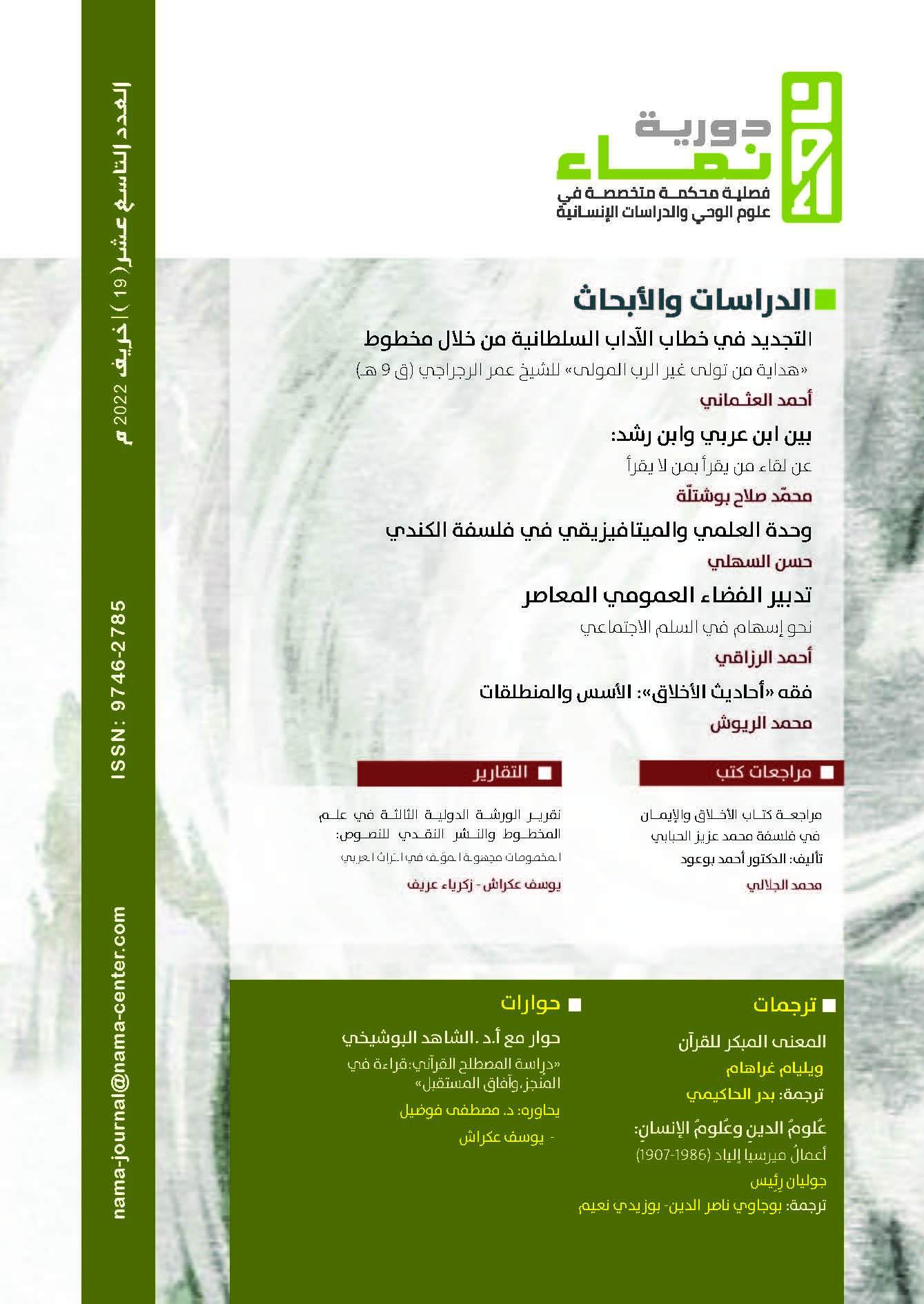
The jurisprudence of "Ahadith of Ethics": foundations and premises

Article Sidebar
-
أحاديث الأخلاق, أخلاق إسلامية, الأحكام, الفقه, الأخلاق Ahadith of Ethics, Islamic morals, Rulings, Jurisprudence, Moral
Abstract
The research aims to know the foundations and premises of the jurisprudence of ethics hadiths, and Perhaps talking about Islamic morals abstracted from practical applications remains of little use, as applied comparative studies are the test of every view that aspires to interrogate the hadith texts and place them within a framework of several rules of jurisprudence. The jurisprudence of hadith is one of the chapters that try hard to solve the problems that appear to be the difference or the refutation of the Sharia with nullity and what is like that. Since it is known that the hadiths of rulings have drawn the attention of jurists and hadith scholars alike, the normative view of rulings through my memorials: “the command and the prohibition” is practical only, was a reason for restricting the attention of the jurists in the past to the legal rulings in “order and prohibition” as normative limits [i.e. : Obligation, scarcity, permissibility, hatred and sanctity] which led to the disappearance of many of the moral, social and psychological dimensions that the texts refer to. In order to answer this problem, the research was divided into three main axes: First: The jurisprudence of hadiths on ethics and the duality of method and tools. Second: Topics of jurisprudence hadiths of ethics: problematic approaches. Third: The jurisprudence of hadiths on ethics: practical attempts.
Full text article
Authors

This work is licensed under a Creative Commons Attribution-NonCommercial 4.0 International License.
yright and License
Researchers always have copyright. The research published in the Journal is licensed under the Creative Commons Attribution-Noncommercial 4.0 International License. This means that every person can download, read and use the research, provided that he/she relates it to its author appropriately, stating any amendments made. This work cannot be used for commercial purposes.